Austin Sapin
21h ago
Mateo Pulcini going to get the Wyndham-Shinnecock treatment at Birkdale.


Early week coverage of the 154th Open Championship at Royal Birkdale
Mateo Pulcini going to get the Wyndham-Shinnecock treatment at Birkdale.
Following Joseph and Brendan's 2017 Open Championship rewatch SGS episode, I was entirely ready to put an asterisk on Spieth's victory. I might have even written it off entirely. Their discussion of where Spieth ended up dropping his ball on the 13th hole after taking an unplayable had me completely convinced that it was scummy and unbecoming. He wound up about 30 yards right of the actual line between the flag and his ball, after all.
This was a very difficult few days for me, a longtime Spieth fan. I can very vividly remember sitting on my friend's living room floor, battling a hangover from the previous night's Beer Olympics, being completely enthralled with the drama happening at Birkdale. It actually became a moment of tension between myself and my friend's girlfiend at the time because instead of helping clean up, I was watching a golfer decide where to drop a golf ball. Thankfully, they broke up, Spieth went on to win, and my decision to shirk any cleanup duties was justified. At least in my eyes.
Anyway, this morning I found Shane Ryan's video breakdown of the entirety of Spieth's drop from 2017. Shane walks through how the situation unfolded minute by minute, including how Spieth ended up between the equipment trucks and ultimately how he found his way out onto the range. Call me a simp or someone susceptible to propaganda, but this breakdown completely vindicates Spieth in my eyes. Is it somewhat scummy and advantageous of the rules of golf? Sure. But I don't think there should be any asterisk on Spieth's 2017 victory. And while we will undoubtedly see infinite clips of that scene this week, we should all move on with our lives.
You can find the full video breakdown by Ryan on YouTube:
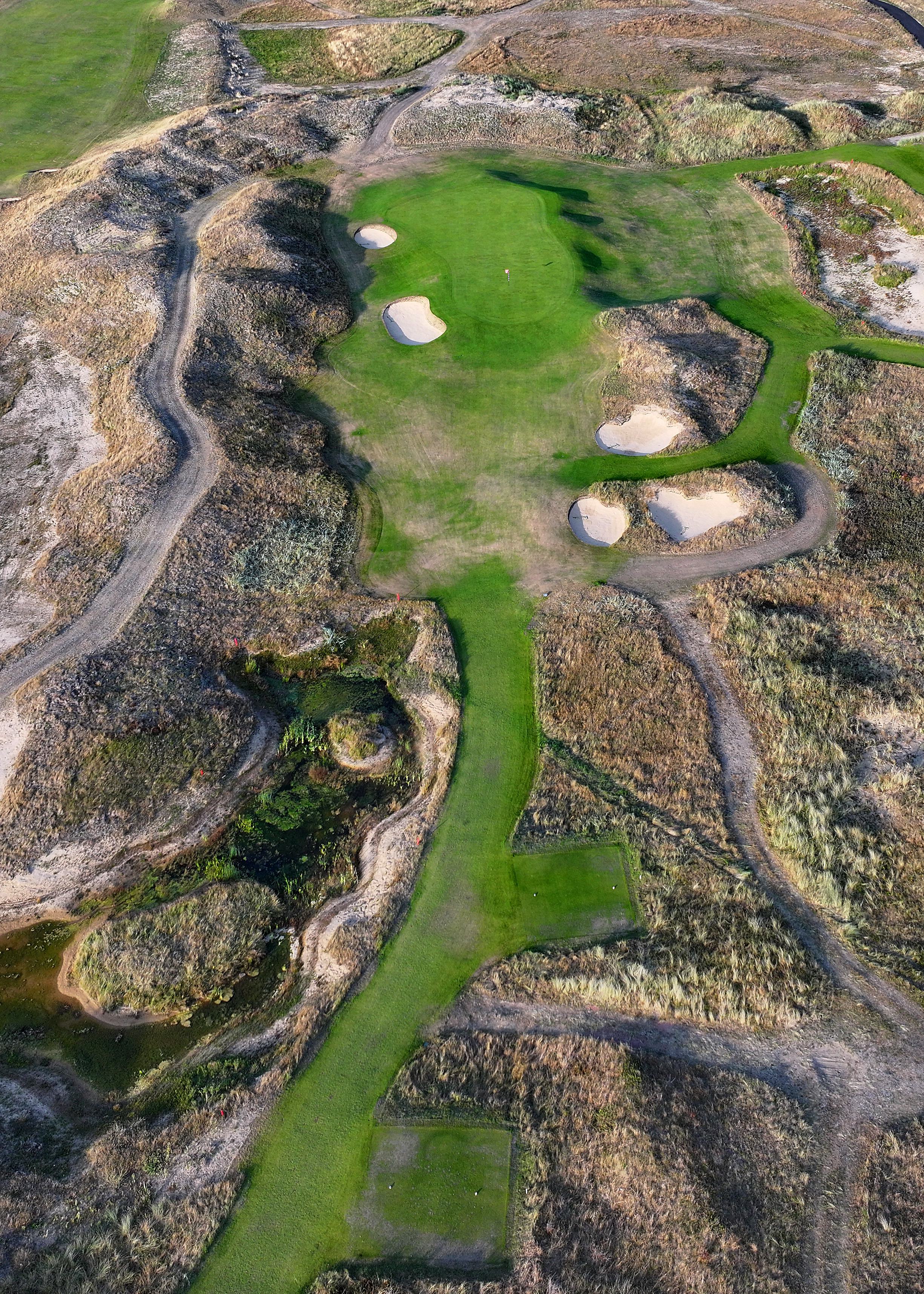
Very large “forged by nature” branding alongside the steep fall off on the right of the 15th green, an entirely new man made par 3.
In his press conference today, R&A CEO Mark Darbon insisted that recent renovations at Open-rota courses like Royal Liverpool and Royal Birkdale have been "club-driven." Yet in nearly the same breath, Darbon said that Muirfield, widely regarded as a near-perfect example of links golf and Harry Colt design, "requires a few tweaks both around the golf course and across the site more broadly" in order to be considered for another Open Championship.
Rumors are starting to circulate about the specific changes proposed at Muirfield. Martin Dempster reported for The Independent that the green on the par-5 fifth hole at Muirfield is set to be moved "to alleviate what the R&A talk about as a 'spectator pinch point.'" I've also heard that the tee and green on the first hole may be moved significantly downrange to create room for spectator flow around the clubhouse.
Do these sound like purely "club-driven" proposals to you?
Doug Ferguson of the AP had it exactly right in his question to Darbon earlier today. The crux of the issue is, "Did [the members] want the change, or did they want it because the R&A couldn't guarantee they'd come back if they didn't?"
It strikes me as obvious that the latter dynamic is present, implicitly or not, in the R&A's relationships with various British and Irish clubs hoping to host future Opens. Otherwise, I find it hard to believe that these different clubs would decide independently to hire the same architecture firm, or to relocate entire holes to accommodate championship infrastructure.
Clearly the R&A has a great deal of influence in the decision-making of rota clubs. I wish Darbon and others at the top of the R&A would 1) admit as much and 2) exercise that influence in ways that respect the history and architecture of the Open's host venues.
After listening to yesterday's Shotgun Start, seeing the golf course in person, and reading reactions to the recent wave of Mackenzie & Ebert changes at Royal Birkdale, I suppose my question is this:
If you were hired to renovate a golf course for modern professional golf championships, and part of the course's identity makes it simple for pros (flat greens, mild green surrounds), would you alter that identity to enhance the challenge or leave it as is?
I understand the "Don't mutilate a sacred golf course" argument. I get it. But flat greens and mild green surrounds are very simple for the modern golfer. (Also, Royal Birkdale isn't necessarily sacred architecture, which I should mention).
The crux of what's happened over time is that Birkdale had so much strength from tee to green that it could test the best players in the world with flat greens and flat green surrounds 100 years ago. Today, that doesn't suffice.
I would also mention that Augusta National has tweaked some of their green surrounds (like behind No. 6), which now look much less natural but also provide a better challenge. I don't want to put words in my colleagues' mouths, but I think some would lament those changes at Augusta too, whereas I'm more sympathetic in the spirit of challenging the modern pro. I'm not sure that I'm right, but it is a difficult trade-off.
There is also some middle ground here, where you can make green surrounds more challenging and severe without making them look funky and unnatural. There are some good critiques to be made of the changes at Birkdale on that front. No. 15 is getting all the attention, but whatever. I don't think No. 15 is nearly as egregious looking as right of No. 5 or left of No. 16. Both look really bad in my opinion. They took two bunkers out left of the 16 green and...you can tell...(pic below).
Anyway, I don't have that strong of an opinion other than to suggest that I am pretty sympathetic to altering green surrounds if the purpose is to host modern major championships. I think it's a good question to ponder for better architecture minds than mine. Whether or not that has been done tastefully - at Birkdale or somewhere else - is mostly a separate question.
There's been lots of golf course content and discourse. With less than 24 hours until the opening tee shot, what's the consensus on Birkdale? Not relative to other Open venues, just evaluate it on its own.
I am reluctant to make 2026 The Open (even for a minute) about who isn't here instead of who is here, but I was struck by something this morning walking into Royal Birkdale and looking at some of the pictures of past champions that the neither Tiger nor Phil competed in a major championship this year. The two men who managed to be a dominant storyline in majors for roughly a quarter century are now absent from the game, both of them dealing with personal issues unrelated to golf.
It's unclear if either will be back at this championship. I suspect they will. St. Andrews will beckon next year. But there are no guarantees.
In 2024, The R&A lowered the age that past champions will be exempt, dropping it from 60 years old to age 55, but both Mickelson and Woods were grandfathered in under the old rules, meaning they could still play until they are 60.
Mickelson turned 55 this July, but did not enter The Open this year for first time since 2009. He didn't play in any of the four majors this season for the first time in his career.
Woods turned 50 this past December, but he hasn't played in a major since 2024.
I wondered when the last time we went an entire season where neither of them played in any of the four majors.
It turns out it was 1989, a number that stunned be a little.
Mickelson made his debut in majors in 1990, when he finished T-29 as an amateur at The U.S. Open. Tiger made his major debut in 1995, finishing T-41 at The Masters. They have been a constant in the world of golf (in some form) ever since. They won 21 majors between the the two of them, remarkably each snagging a final major in the twilight of their careers. When Tiger slipped on a fifth green jacket in 2019, and Mickelson became the oldest major winner in history at Kiawah in 2021, who could have predicted we'd end up here, both of their reputations damaged, their lives embroiled in scandal and controversy? It's easier to see the warning signs in retrospect, but that doesn't make it less sad.
We overuse the world tragedy with regards to sports. It's not quite that. But it's tragic in the Shakespearean sense that neither of them is getting the kind of exit that Arnold Palmer, Jack Nicklaus and Gary Player enjoyed — the long, warm goodbye that golf loves to deploy in celebration of its legends. Their joint fate feels like it was written as literature instead of cinema. The strains of modern fame did a number on each of them, but it was their choices that ultimately made the biggest impact.
Maybe they'll return for an encore, one final walk and wave across the Swilcan Bridge in 2027. They also might not. They ending might have already come and gone with little to no ceremony.
It's not that we didn't care. It's just that we didn't know if there was anything left to say.
It's 82 degrees, dry, and sunny as ever. Media lunch options today are meat pies, and beef or veggie chili. Would you rather something here or Sergio's lasagna?
In conversations off the record in private, on podcasts, in articles, and elsewhere, the R&A, as well as Royal Birkdale, have strongly emphasized that all the course work done for this week's Open was done at the initiation of the club. The club wanted the changes, contracted for them, influenced them, and made them. The R&A wants to reiterate this.
This very deliberate emphasis by the R&A continued this morning with Mark Darbon:
Q. Just following up on that and Muirfield in particular, but there's a growing perception that The Open rota venues need to architecturally change to accommodate the fan experience, and that's not always well-received. Do you understand that perception, and what do you say to those who are critical of changing sometimes time-tested courses like Muirfield?
MARK DARBON: I think what I would say, first and foremost, is that these are all members' clubs. So a lot of the decision-making is driven by the members themselves. I think where we are this week is a brilliant example of that. The changes to the golf course have been driven by the members.
The R&A seems to be extremely sensitive to the potential critique -- whether accurate or not, they are still preemptively acknowledging and rebutting it -- that they are forcing clubs to renovate, change holes, move earth, and adapt to accommodate their four-day championship, and often with the firm of Mackenzie & Ebert doing the work on behalf of the club (not as an R&A preferred firm, which is another critique).
Darbon was quick to cite club preferences and demands in a conspicuous way. Doug Ferguson of the AP rightly followed up with a question about changes that are member-driven but only because of the soft power of the R&A and looming desires to accommodate an Open.
Q. I want to revisit the idea of adding a new hole to a century-old links. When you talk about the members driving the change, did they want the change, or did they want it because the R&A couldn't guarantee they'd come back if they didn't?
MARK DARBON: The decisions were made before my time, but at no stage would we threaten a non-return to a venue on that basis. We've held -- this is our most visited venue outside of St Andrews, so we've found a way to work with this venue operationally really seamlessly in the past. So there would certainly be no threats on that front.
As the members considered some changes to their golf course, as I said earlier, they invited us into that process. It's a process that we would be very keen to be part of. I think we've struck the right balance with evolving this golf course, and the feedback that we hear from the membership base is very, very positive indeed.
Brandel might have cooked here:
“It’s almost like [Bryson] went from chasing Scottie Scheffler and Rory McIlroy to chasing Grant Horvat. It’s like he wants to outdo every YouTuber in the game of golf instead of outplay everybody in the game of golf.”
Mark Darbon, the CEO of the R&A, sat for his annual press conference this morning at The Open Championship and hit on a number of topics. I would not describe it as a particularly eventful or contentious presser, which is in line with Darbon's personality and the R&A's wishes. There will be a fan conduct policy in place this year to kick out potential miscreants, the prize money for The Open increased again ($3.2 million to the winner and $17.5 million overall purse) but not dramatically. If you want tickets to St. Andrews in 2027, you'd better say a prayer to the gods. The R&A has already received more than 750,000 applicants in the nine days since opening the ballot. The R&A seems optimistic that the PGA Tour and its players are more open to some kind of rollback in 2030, and is going to work with them on curtailing distance to some degree.
The most interesting tidbit from Darbon — albeit still purposefully vague — had to do with three potential Open venues on the horizon: Portmarnock, Muirfield and Turnberry.
Portmarnock is still on track to become the first golf course outside the United Kingdom to host The Open. Reading between the lines, Darbon more or less confirmed the R&A is going to get that deal done eventually. It's just taking a bit longer than expected to work out the details.
"I think we're getting pretty close," Darbon said when asked about Portmarnock. "It's a complicated venue because of the scale of The Open Championship. So there's been a lot of great feasibility work with the golf club themselves, with the local authority, with government. We've undertaken a big feasibility study. That work is pretty much done. We've confirmed that we believe we can take an Open Championship there.
"What we're looking to do is build a model that opens up opportunities for the AIG Women's Open and The Open for many, many years to come. So that's the dialogue we're in right now with the Irish government, and we're optimistic that those discussions are heading in the right direction.
"Time frame? Look, in the spirit of transparency, it's taken a bit longer than I think I and we thought it may, but it's complicated doing all of that feasibility work. We're hoping to have a pretty clear view by the end of the year for sure."
It's likely there is no opening on the schedule for Portmarnock until 2034, and the logistics of getting fans to the venue (which might require boats) is part of the negotiations. But eventually we are likely to see The Republic of Ireland host The Open Championship.
Muirfield — which last hosted The Open in 2013 — will likely get another Open at some point, but those negotiations are still in the earliest stages.
"We've got a great dialogue with Muirfield," Darbon said. "We've just staged a really successful Amateur Championship there for the women. We're excited to return an Open Championship to that venue in the future. It requires a few tweaks both around the golf course and across the site more broadly, but it's a good dialogue with the club and one that we'll maintain."
Darbon wasn't asked about Trump Turnberry (which has hosted four Open Championships, but none since 2009) in his main press conference, but it a brief scrum with reporters he was asked if there is any update on negotiations with the club.
"We continue to study the feasibility of the venue," Darbon said, which is essentially bureaucratic-speak for No Comment.
Darbon did push back a bit on the idea that The Open has grown into such a behemoth that the R&A will no longer take it to smaller venues.
"We're going back to Lytham in a couple years time," Darbon said. "Lytham has a much smaller footprint. There's absolutely no way we'll be near the volume of spectators at Lytham that we have here this week. So our choices, first and foremost, start with the underlying principle for us, which is we want to take The Open Championship to venues that will offer a true test of links golf. We're not taking venues off the rotation because they're smaller than others, but there's a balance to be struck too, and we think we're getting that right."
At the R&A press conference, Mark Darbon has just announced a new Spirit of Golf award they have created to give to someone who exemplifies the values golf on a global platform.
He announced first recipient is Adam Scott.
I don’t mean to be cynical (maybe), but I think we just need a rollback in awards, platters, honors, medals, and whatever else has been cooked up for reasons the last several years.
A significant theme of Scottie Scheffler's season of close calls has been the drain, demand, and burden that comes with being the world No. 1 and defending champion at multiple majors. This has been known and present for months now but Scheffler acknowledged it quite openly on Tuesday.
I think it's more just like mentally, especially in this day and age, there's just a lot of noise all the time at golf tournaments...
I think, just being in the spotlight all the time puts a burden on a player in this day and age. Everything is being recorded. When they say hello to you, they've got their cell phone out. Sometimes you can be like you're walking on eggshells a little bit, and that can drain people.
For me, that's why I say I can't play so many tournaments a row because of the demands you have in a given week, and being recorded all the time, I'm very far from a perfect person, and you know -- I'm trying to find the right words, but I think just sometimes it can be hard when you're being recorded all the time.
Anyways, this quote immediately came to mind again as I watched him going through his routine on the putting green this morning . Scheffler was in animated discussions with Phil Kenyon (to be clear, this could have been about the Dallas Cowboys and not the state of his putting) and quite focused on the work at hand. As he moved on, he was stopped by a social producer to take a picture with an Open flag for some endeavor or activation. This came after the champions challenge late yesterday and the official returning of the jug ceremony. It's a great life to be world No. 1, but some of the extra obligations do not go unnoticed with Scheffler.
Ben Griffin (via IG) breaking out the vintage Maxfli styled bag this week. If only Ben had the gall to play a retro set of Maxfli Australian blades and revolution ball along with it
Just about set to go LIVE on YouTube for this week's SGS preview episode: https://www.youtube.com/live/VjsbJmssosY?si=ahu4pxi_zFikW_4T
I know it's a major championship so excitement is generally the norm, but I would describe the vibes on the ground as incredibly high after today. The conditions certainly build into this. But I do think -- SO FAR -- there is a general curiousity-to-enthusiasm about the course changes. This, of course, can change rapidly in the next couple days, and the conditions will aid or overshadow some of the substantive changes. But I think there's mostly interest around the new routing and work done on both nines.
The biggest criticisms so far, on the record at least, have centered around the new holes/greens on the back nine sticking out significantly and not looking natural compared to the rest of the course. Both Scottie and Rory lodged these comments, and I am not sure, at least on Scottie's part, it was intended as a criticism so much as an observation.
SCOTTIE SCHEFFLER: First impressions were really good. I think it's pretty obvious -- the one thing I found interesting is it's so obvious as to which holes had been redone. They look like they're not even on the same golf course. You look at 14, 15, 16, those green complexes and the amount of slope that they have off of them are pretty severe and quite challenging. The 5th hole is kind of like that, 7th hole as well.
It was pretty obvious like, oh, these are the holes that got redone because they look like they're on a different golf course. Those are the things that stood out to me the most.
I do think it is likely that the final judgment at the end of the week on the new par-3 15th hole will not be a favorable one. None of the pros are running balls on there, and I think they might get testy about it. Paul McGinley suggested there are already plans to scrap it when The Open is over.
But so far -- from the players to the fans to the media -- there is just a very positive feeling permeating the premises of the last men's major of the year.
The 15th hole, a new par 3 that and push toward 250 yards (likely downwind), courtesy of Getty/David Cannon.
Powerful segment on Live From, bringing on 27-year-old amateur David Howard, who was diagnosed with cystic fibrosis at age seven. Howard qualified for this Open via Final Qualifying at Dundonald Links.
Brandel Chamblee asked Howard about dealing with his diagnosis and that one of the first things Howard did when he received a phone was search the internet for the life expectancy of someone with cystic fibrosis. The Irishman, who is a trained mechanic, has gone through his fair share of personal struggles, but this week he'll compete head to head with the best golfers in the world.
The next time a professional golfer complains about an unfair bounce or the lack of gluten-free options at player dining, they should think about Howard taking 25-30 tablets a day to get his body through each round. An inspiring story of perseverance, courage, and the importance of Open Qualifying.
This might seem like an odd thing to admit, but press conferences at The Open Championship are typically my favorite press conferences of the year.
The players are usually in a good mood, but also in a reflective one. It's the last major of the year, so there is still time to salvage a poor season with a win. Most of them don't play a lot of links golf, but they have an unspoken reverence for the origins of the game, so coming to this part of the world puts them in thoughtful place. There is also a large menagerie of media on site, so you get a lot of variety in the questions.
One minute you might have someone asking Scottie Scheffler about the newly-designed 15th hole, the next minute you might have someone asking Rory McIlroy if he wants to be knighted and if he's inquired about the application process.
Those are two real things that happened Tuesday.
Asking questions in press conferences is a bit of a misunderstood part of our jobs, if I'm being frank. Context often gets stripped away when things are clipped and reshared on X, and it's inevitable that people declare we've just asked the dumbest possible question, how do we actually have jobs, what the hell could we possibly have been thinking by bringing up such a stupid inquiry.
I push back on the idea that any question in a press conference is dumb or inappropriate. Our job is to get insight for something we're working on or something we're curious about, not to perform for an audience on social media. In fact, sometimes (often, in fact) unusual questions produce the best answers. It was AP reporter Doug Ferguson who asked Scheffler last year at Royal Portrush what was the longest he'd ever celebrated something, and Scheffler gave one of the best answers of his career, opening up about the meaning of life and how golf wasn't ultimately fulfilling, something that ended up resonating with me deeply.
Scheffler couldn't resist revisiting the same subject matter on Tuesday, even though he kept joking that he'd like to steer away from big themes this year. Shane Ryan of Golf Digest (one of the best when it comes to asking good questions) wanted to know if he ever thought about legacy, if he wondered how he might be remembered when he was gone.
"There's things I would like to accomplish in the game, but at the end of the day, I have never once thought about how I'm going to be remembered," Scheffler said. "To me, it truly doesn't matter from a sense of like accomplishment. Like when I die, hey, Scottie won four majors and 20 tournaments and he won this much money. That has zero effect on me.
"When I was young, I took myself a bit too seriously. I've gotten better as I've gotten older of letting the competition be the competition, and when you're done, taking your hat off and shake hands and we're on to the next week. History for me has never been the most important thing."
Twenty mins later, Ryan decided to pose the same question to McIlroy.
"I would like to think that the people that love and care about me think a certain way of me, but yeah, I'll be long gone. I'll be dead," McIlroy said. "I don't think I'll be seeing what people say about me. I'll be six feet under. I don't think I'll be a ghost."
I've always been interested in big themes, and figure I'll let other people dig in on the minutia of golf stuff, in part because I tend to believe professional golfers are such savants when it comes to the game, a 10-handicap like me is never going to be able to relate to them in terms of golf ability. But on a human level, we process some things the same way. So when it was my turn to ask a question, I threw one of my favorites at Jon Rahm.
How do you deal with doubt?
"You're making me doubt myself right now," Rahm joked.
I laughed but I pressed on. How had he learned to deal with it?
"I think it's part of being a pro athlete," Rahm said. "I think it's a part of being a human being, right? I don't think you're ever always 100 percent convinced something is going to happen, and that's why you put the effort that you put in. I think essentially it's just part of the process where you work as hard as you can to prepare, you try to compete. If things go well or not, you learn from what you did and try to be better prepared for the next one."
Had there been any time recently when he'd learned something about himself after coming up short? Rahm thought deeply about it, then gave a really insightful answer.
"Best example I can give you from this year is Australia, being tied for the lead with Bryson and Anthony Kim in the final group and having a very lackluster Sunday, learning a lot precisely from what I witnessed Anthony Kim do," he said. "Took that to two weeks later at Hong Kong where I was tied for the lead with two other players and actually getting it done. So, yeah, there's cases and there's times where you learn from your mistakes. I think you need to be honest enough about it with yourself to maybe swallow your pride, understand what you did wrong, see what somebody else did better, and try to change that."
McIlroy didn't love the question about being knighted — I suspect it's the kind of thing you don't talk about if you have any interest in seeing it happen — but that didn't mean it was a bad question. Sometimes you shoot your shot as a reporter and strike out.
And sometimes you step in it when you're fumbling with your words, as I did when I asked McIlroy about what was his favorite venue in the "British Open" rota before correcting myself too late and saying "The Open."
"Come on, Kevin," Rory said.
At least no one will remember that faux pas when I'm gone.
I know my colleague Joseph LaMagna will back me up on this after getting his first dosage of it last year at Royal Portrush.
The Open has many great traditions. The Claret Jug. The links. The weather. The overnight watch from the USA. One of the absolute best, and you can take it to the bank every single year, is watching Geoff Shackelford mock, lambaste, and recoil at the food offerings in at the media dining station as the servers wait, within earshot of the reviews, for him to make a selection. It is high comedy, some of the best theater of Open Championship week each year. I just had an experience that ended with tears from laughter.
My personal approach is to go safe as possible -- plain breads and starches. It's not healthy and hurts in the end, but it's the safer of all roads.
By now, you've likely heard about the fiery conditions at Royal Birkdale. The area is in its third heatwave of the summer with little interluding rain. The course is indeed a golden brown, with some of that occasional grey or white creeping in spots. I had not been out before today, but I did take an early stroll with Geoff Shackleford who remarked that they had clearly put some water on it overnight to keep things alive and reasonable. It will remain fiery and the colors will pop on television in a diametric way to Augusta, Quail Hollow, and places that dot the American TV golf landscape.
https://x.com/BrendanPorath/status/2077006955844116788
What does it mean for the championship? Well, we will see! I know you come to this blog for that kind of expert analysis. But I do think we've arrived at another major this year where there is a bit of mystery on what kind of style will succeed and what kind of challenge might await. Aronimink was a bit of a mystery, a relative unknown on the recent majors rota, whose greens combined with the winds that came during that major to create a delightful and maybe not entirely anticipated challenge. Shinnecock became all about the setup in a forecasted wind that became somewhat terrifying for the setup guys like John Bodenhamer. Anticipation and the excitement that comes with uncertainty ensued.
Now we come to another major championship week where the only consensus right now is that the conditions are firm and fiery. The prevailing notion early on is that we will see a lot less drivers. Jon Rahm spoke of 6 irons nearly running into bunkers 280 yards off the tee at 11. Scottie Scheffler said, more importantly than the color, is the firmness.
I'm looking forward to getting out here on a really firm golf course. I think it's going to be very fun and interesting to play. St Andrews was really firm, but outside of that, I haven't played an extremely firm Open Championship yet, so I'm excited to get out there and see what it's like under competition as well.
Scottie also suggested that drivers will almost always run into the rough should you choose to hit them.
So there's a lot of thinking off the tee on whether or not you want to just hit driver up there somewhere and kind of play from the rough most likely, or do you want to start hitting some irons, getting it in some fairways and hitting some longer shots into the greens?
On each hole there's a good bit of strategy; there's a decent amount of thinking. If it wasn't as firm as it is now, there wouldn't be as much decision-making, but I think with the firmness, it creates a whole lot more challenges, I think, for us as players, just to try and control your ball and figure out where it's going to end up.
So we're certainly in for something different this week, which at the start of it, is great. At the end of it, if we've seen just a bunch of six iron-wedges, will that positive feeling be the same? Is removing driver as a significant part of the competition going to yield a better championship? We'll see. This is where the mystery of another major and the expectations for what we will come is a welcome refresher.
By the way, what does it say for so much of the other golf throughout the year that this major, and the preceding two majors, feel anomalous? That there is a bit of excitement because we don't know precisely what to expect. That seems suboptimal, and controllable if you're some of those other events.
Scottie might just be back. On if playing for legacy motivates him:
"I don't play for a place in history. I'm not playing for anything like that because -- this is going to sound a little morbid, but at the end of the day, I'm going to live my life and then it's going to end and when it ends I'm going somewhere else and I'm not going to be here anymore."
A great quote on links golf from Justin Rose this morning:
"I think as pros we love to be prepared. Really to answer your question, it's we love to be prepared. I think ultimately at an Open Championship, your preparation needs to be -- you can't perfect something. Play with creativity and play in the moment. Just play with a lot of flair in the moment. See a shot, bump and run. You might not have practiced it, you might not have hit that shot for a long, long time, but if you see it, go with it."